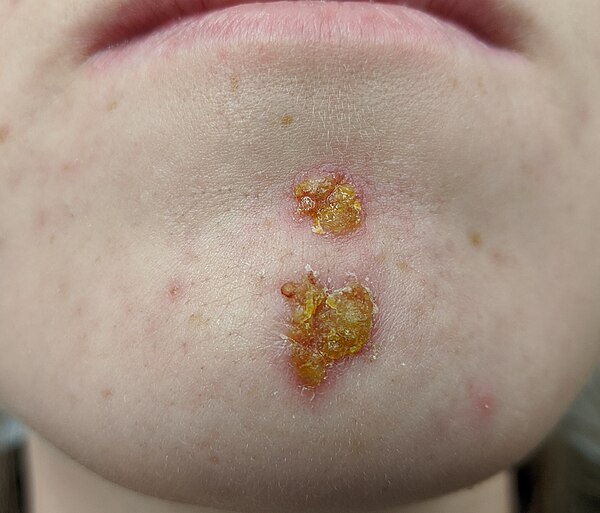
Impetigo is one of the most common bacterial skin infections in children, but it can affect any age group. It is highly contagious, which is exactly why it matters to start treatment promptly and to know when a child can return to nursery or school.
In this article we explain what impetigo is, what it looks like, who gets it, when it is urgent, and how it is treated in Denmark.
What is impetigo?
Impetigo is a superficial bacterial skin infection of the epidermis — the outermost layer of the skin. It is caused by Staphylococcus aureus (staphylococci) and Streptococcus pyogenes (streptococci), which enter through small cracks, grazes or insect bites. In Denmark and other high-income countries S. aureus is now by far the most common cause; streptococci are more often responsible in warm climates and in crowded living conditions.
Impetigo is highly contagious and spreads from person to person through direct contact or via objects the bacteria have been on. In the great majority of cases the illness is mild and is treated effectively with antibiotics.
When is impetigo an emergency?
Impetigo is almost always a local and harmless infection. The toxins that cause bullous impetigo can, however, rarely spread through the body and affect the skin all over — particularly in small children and newborns.
When to seek urgent help
Contact a doctor the same day — or the out-of-hours service outside surgery hours — if a child with impetigo has widespread red, painful skin that peels away in sheets, has a fever, is floppy or unusually unwell, or if the redness is spreading quickly and the skin becomes swollen and hot. Skin peeling together with fever can be staphylococcal scalded skin syndrome (SSSS), a toxin-driven condition that needs hospital treatment. Impetigo in a newborn should always be seen the same day.
Rapidly increasing redness, swelling and warmth around the sores can also mean the infection has reached the deeper layers of the skin as cellulitis, which needs treatment with oral or intravenous antibiotics.
What are the two types of impetigo?
There are two main types of impetigo:
Non-bullous impetigo (the most common)
This is the most common form, accounting for about 70% of all cases. It typically starts as small red spots around the mouth and nose, which quickly turn into small blisters. When the blisters burst, they leave the characteristic honey-coloured or yellow crusts, which can look like dried honey or wax.
Bullous impetigo
Bullous impetigo is caused specifically by Staphylococcus aureus, which produces toxins that loosen the outermost layer of skin and create larger, fluid-filled blisters — often on the trunk, arms and legs. The blisters are larger than in non-bullous impetigo and burst more slowly, leaving thinner, yellow crusts. These are the same toxins that, in widespread disease, can cause staphylococcal scalded skin syndrome.
What does impetigo look like?
Common signs of impetigo include:
- Red, irritated patches: Especially around the mouth, nose and other exposed areas of the face.
- Honey-coloured or yellow crusts: The most recognisable sign. The crusts form when the blisters burst.
- Itching and discomfort: The sores often itch. When a child scratches them, the bacteria spread to new areas of skin and to other children — which is why short nails matter.
- Swollen lymph nodes: In some cases the lymph nodes near the infection become swollen and tender.
Why does impetigo happen?
Impetigo occurs when bacteria enter through a break in the skin barrier. Even very small injuries are enough:
How do the bacteria get in?
Cuts, grazes, insect bites and even small cracks in the skin give bacteria a way in. Eczema and other chronic skin conditions weaken the skin barrier and raise the risk noticeably. In children, impetigo particularly often develops after vigorous scratching of itchy skin.
How does impetigo spread?
Impetigo spreads through direct contact with someone who has the infection. The bacteria can also be transferred via towels, flannels, bedding and toys. This is particularly relevant in nurseries, schools and crowded living conditions.
Who gets impetigo?
Impetigo can affect anyone, but certain groups are particularly vulnerable:
- Children between 2 and 6 years: This is the most commonly affected group, mainly because of close physical contact in play, minor injuries and frequent scratching.
- Children in nursery and school: These settings are classic environments for impetigo outbreaks because of the close contact between children.
- People with eczema or dermatitis: The damaged skin barrier makes it easier for bacteria to colonise and infect the skin.
- People with weakened immune systems: A weakened immune system makes it harder for the body to fight off bacterial infections.
How is impetigo treated?
Impetigo is treated with antibiotics. The choice depends on how widespread the infection is and where it sits:
Wound care for a few small sores
Wash the affected areas with soap and water and gently soften the crusts. In Denmark there is no over-the-counter product for impetigo — the hydrogen peroxide 1% cream used in some other countries is not sold here, so treatment is prescription-based. If the sores are not clearly improving within 48–72 hours, contact a doctor rather than waiting any longer.
Topical antibiotics (prescription)
Fusidic acid cream is the first choice in Denmark for localised impetigo, usually for five days. Mupirocin is generally kept in reserve to limit the development of resistance. Fusidic acid resistance in Staphylococcus aureus is a recognised problem in Denmark, which is one reason a treatment that is not working should be reviewed by a doctor rather than simply repeated.
Oral antibiotics
For widespread or bullous impetigo, or when the child is unwell, antibiotics are given by mouth. Dicloxacillin is usually the first choice in Denmark; clarithromycin or erythromycin is used if there is a penicillin allergy.
Hygiene and staying home
Keep the sores clean and covered. Do not share towels, flannels or bedding, and wash hands often. Danish guidance from Sundhedsstyrelsen is that a child can return to nursery or school 48 hours after starting antibiotic treatment — or, if no antibiotic is given, once all the sores have dried and crusted over.
Medical classification: Impetigo is classified as 1B72 in the WHO's International Classification of Diseases (ICD-11). It is a bacterial skin infection presenting with honey-coloured crusts.
Frequently asked questions
Is impetigo dangerous?
Impetigo is rarely dangerous in otherwise healthy children and adults, and it usually clears with antibiotic treatment. Left untreated, the infection can spread into deeper layers of the skin, and streptococcal impetigo is in rare cases followed by kidney inflammation (post-streptococcal glomerulonephritis). It is worth knowing, though, that antibiotic treatment of impetigo has not been shown to prevent that kidney complication — the reasons to treat are to relieve symptoms and to stop the infection spreading.
When can my child go back to nursery?
Danish guidance from Sundhedsstyrelsen is that a child can return to nursery or school 48 hours after starting antibiotic treatment. If no antibiotic is given, the child should stay at home until all the sores have dried and crusted over.
How do I prevent impetigo?
Good hand hygiene matters most. Wash hands regularly with soap, avoid sharing towels and flannels, and keep small cuts and grazes clean and covered. If your child has eczema or other itchy skin, keeping the nails short and the itch under control helps stop the skin being scratched open.
When should I contact a doctor?
Contact a doctor if the sores are not clearly improving 48–72 hours after treatment has started, if the infection is spreading, or if a fever or swollen lymph nodes appear. Seek help the same day if the skin is red, painful and peeling away in sheets, if the child is floppy or seems unwell, or if a newborn is affected.
Get an assessment within 48 hours
If your child has a fever, is floppy or seems unwell, if the skin is peeling in sheets, or if the redness is spreading quickly, contact a doctor or the out-of-hours service the same day rather than waiting for an app assessment.
For ordinary sores that are settling, or if you are simply unsure what the rash is, you can upload photos via the SKIND app and get an assessment from a certified dermatologist.
Disclaimer: This article is for informational purposes only and does not replace professional medical advice. Always consult a doctor or dermatologist for personal guidance and assessment of skin changes.