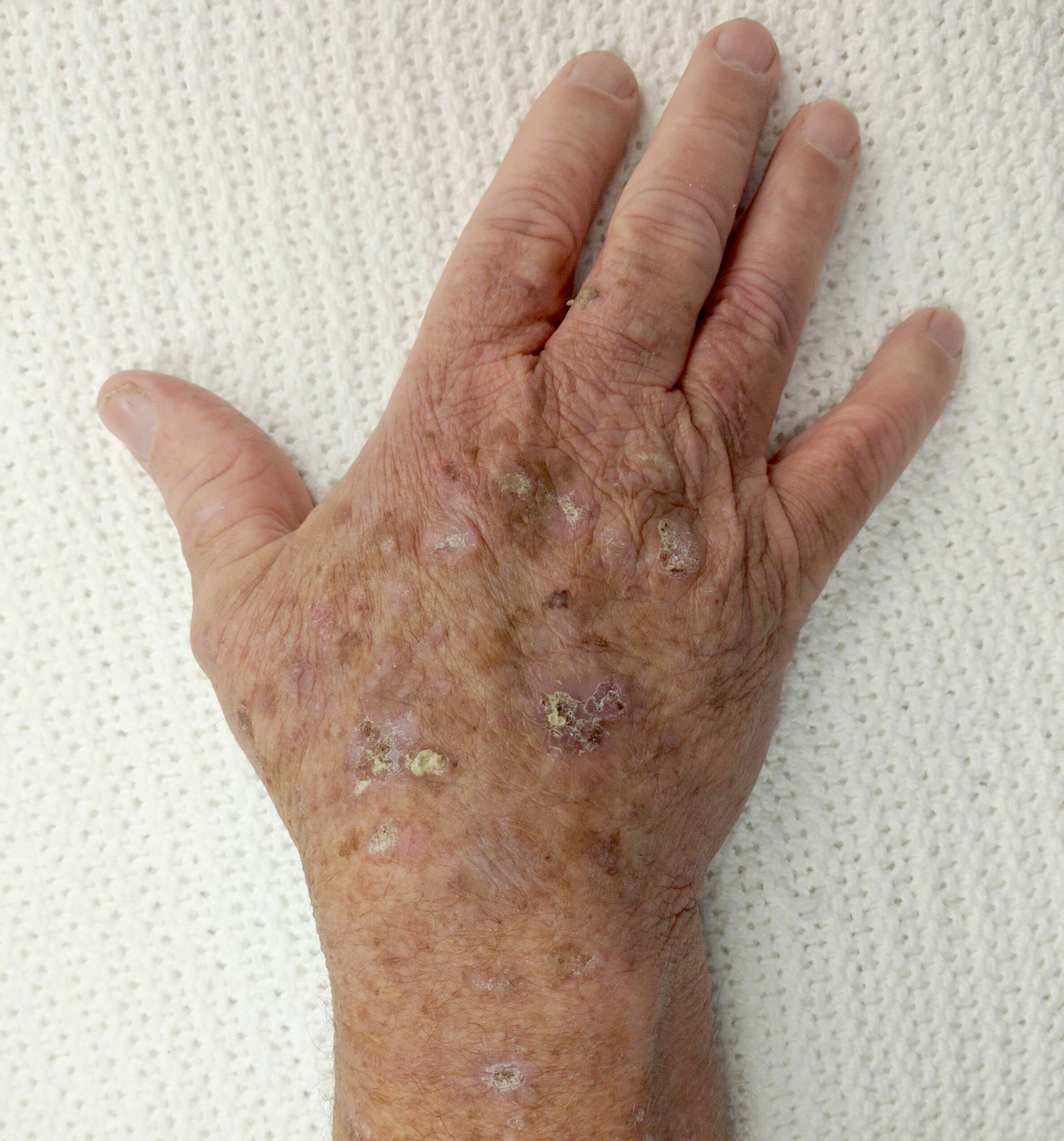
Actinic keratosis (AK), also called solar keratosis, is a rough, scaly patch of skin caused by years of sun exposure. The patch is not cancer in itself, but it sits in skin where UV radiation has damaged the DNA of the cells — and a small proportion of these patches can over time develop into squamous cell carcinoma.
In this article we explain what actinic keratosis is, what it looks and feels like, why it happens, who is at risk, when you should see a doctor, and which treatments dermatologists use today.
What is actinic keratosis?
Actinic keratosis develops when skin cells called keratinocytes are damaged by cumulative UV exposure over a lifetime. The damage alters the DNA of the cells so that they grow abnormally and build up a thickened, scaly layer on the surface. The patches almost always sit in skin that has had a lot of sun over decades, and they rarely come alone.
Is actinic keratosis cancer?
No — an actinic keratosis is not cancer in itself. But it is not simply a dry patch either. Contemporary skin pathology regards AK as the earliest, most superficial step in the same disease process that ends in squamous cell carcinoma. The abnormal cells are still confined to the epidermis and have not broken through into the tissue below. That is why the condition is called precancerous — and why it is treated.
What does actinic keratosis look like?
AK typically appears as small, rough or scaly patches that may be pink, red, skin-coloured or brownish. They are often easier to feel than to see: the surface feels like fine sandpaper, and a patch may come and go through the year. Some are tender, itchy or prickly, and a thick, horn-like growth (a cutaneous horn) can arise from an actinic keratosis.
Where on the body do actinic keratoses appear?
Almost always on the areas that have received the most sun over a lifetime: the face, nose, ears, lower lip, a bald or thinning scalp, the neck, the forearms and the backs of the hands. In men with hair loss the scalp is a very common site, because the hair no longer provides shade.
What can be mistaken for actinic keratosis?
Several skin changes resemble AK. A seborrhoeic keratosis sits on top of the skin as a waxy, stuck-on brown growth and has nothing to do with sun. A basal cell carcinoma can be a flat, pink patch with a slightly raised edge that bleeds and crusts. Eczema and psoriasis also produce red, scaly areas, but they usually itch more and appear symmetrically on both sides of the body. If you are in doubt, the patch should be seen by a doctor.
Why does actinic keratosis happen?
The cause is cumulative ultraviolet radiation. It is not any single sunburn but the sum of all the sun the skin has received over decades that determines the risk. That is why AK typically affects people over 40–50, and why the patches appear exactly where the sun has struck hardest.
What does UV radiation do to the skin?
UVB radiation strikes the DNA of the cells directly. The skin repairs most of it but not all, and over the years mutations accumulate — among them in the tumour suppressor gene p53 — in more and more keratinocytes. When enough faults have gathered in the same cell line, the cells divide uncontrollably and an actinic keratosis becomes visible.
Who gets actinic keratosis?
AK is one of the most common reasons for seeing a dermatologist in Northern Europe. These groups are particularly exposed:
- Fair skin: Fair skin, light eyes and blonde or red hair give the least natural protection against UV.
- Age over 40: The risk rises with every decade because UV damage accumulates.
- Outdoor work and outdoor hobbies: Builders, farmers, sailors, golfers and cyclists accumulate many hours of sun each year.
- Sunbeds and sunny holidays: Both add substantially to the total UV dose.
- A weakened immune system: Organ transplant recipients and others on immunosuppressive treatment develop more numerous and more aggressive lesions and should be followed closely.
- Previous skin cancer: If you have had skin cancer before, both new keratoses and new skin cancers are more likely.
When should you see a doctor?
Have any rough, scaly patch that persists beyond a few weeks assessed. An individual actinic keratosis carries a low annual risk of turning into squamous cell carcinoma, but across a patient with multiple lesions the risk is meaningful — around 6–10% will develop an SCC over ten years. This is one of the main reasons AK is treated and followed up.
When to seek prompt assessment
Seek assessment promptly if a lesion becomes thickened or hard, tender or painful, bleeds, ulcerates, or grows quickly. These changes can mean it has already become a squamous cell carcinoma. The same applies to a sore on the lower lip or ear that will not heal.
A photo assessment can tell you whether a lesion looks concerning enough to be seen in person, and how quickly. It cannot rule out skin cancer. A suspicious spot needs examination with a dermatoscope and, if there is any doubt, removal of the lesion for laboratory analysis.
How is actinic keratosis treated?
The choice of treatment depends on how many lesions you have, how thick they are, where they sit, and how much of the skin is sun-damaged:
Cryotherapy (freezing)
The most common treatment for individual lesions. Liquid nitrogen is sprayed onto the patch for a few seconds and destroys the abnormal cells. The area turns red, crusts and heals over a couple of weeks, often leaving a pale mark.
Topical treatment (creams and gels)
Creams and gels you apply yourself over days to weeks: 5-fluorouracil (5-FU), imiquimod, tirbanibulin (Klisyri, approved in the EU in 2021 and used for five days) and diclofenac gel. They cover a whole area and make the skin red, sore and crusted along the way — an expected part of the effect, not a reason to stop.
Photodynamic therapy (PDT)
A light-sensitising cream (ALA or MAL) is applied to the skin and is then activated by light of a specific wavelength, which destroys the damaged cells. PDT gives a good cosmetic result over large fields but can sting during treatment. Daylight PDT is a gentler variant.
Surgical removal or biopsy
If a lesion is thick, hard or returns after treatment, it is scraped or cut away so the tissue can be examined under a microscope. That is the only way to establish whether it has already become a squamous cell carcinoma.
Why is a whole area treated rather than one spot?
Dermatologists talk about field cancerisation. The patch you can see is rarely the only one: the whole sun-exposed field — a bald scalp or a forearm, for example — contains cells carrying the same UV damage, and new patches appear in the months that follow. That is why a whole field is often treated with cream or light rather than one lesion at a time, and why your doctor may suggest treating skin that still looks normal.
How can you prevent actinic keratosis?
Sun protection works even after the first patches have appeared: it slows new lesions and reduces the risk of skin cancer.
- Sunscreen every day: Broad-spectrum SPF 30 or higher on the face, ears, neck and hands — also on cloudy days.
- Seek shade in the middle of the day: UV radiation is strongest in the middle of the day (12–3 pm).
- A hat and clothing: A wide-brimmed hat protects the scalp, ears and lower lip — precisely where AK most often appears.
- Never use sunbeds: Sunbeds add pure UV dose with no health benefit whatsoever.
- Monthly self-examination: Run your fingertips over the scalp, face, ears and forearms — keratoses can often be felt before they are seen.
- Dermatologist check-ups: If you already have keratoses, previous skin cancer or a weakened immune system, you should be followed up regularly.
Medical classification: Actinic keratosis is coded EK90.0 in ICD-11, the WHO International Classification of Diseases. The code sits within the block EK90, actinic keratosis and other discrete epidermal dysplasias, and covers abnormal keratinocyte growth caused by chronic ultraviolet radiation.
Frequently asked questions
What is actinic keratosis?
Actinic keratosis (AK), also known as solar keratosis, is a precancerous skin condition with rough, scaly patches. The lesions develop after many years of exposure to ultraviolet radiation from the sun or tanning beds, and they sit in skin where UV radiation has damaged the DNA of the cells.
What does actinic keratosis look like?
AK typically appears as small, rough or scaly patches that may be pink, red, skin-coloured or brownish. They feel like fine sandpaper and are often easier to feel than to see. They sit on sun-exposed areas such as the face, ears, lower lip, bald scalp, neck, forearms and backs of the hands.
Who gets actinic keratosis?
AK is most common in fair-skinned people over 40, but it can affect anyone with many years of sun exposure. Outdoor workers, former sunbed users, people with a weakened immune system and organ transplant recipients have a markedly higher risk.
What should I remember about actinic keratosis treatment?
AK is treated because it can progress to squamous cell carcinoma: across a person with multiple lesions, around 6–10% develop an SCC over ten years. The options are cryotherapy, creams such as 5-fluorouracil, imiquimod or tirbanibulin, photodynamic therapy and surgical removal. Often the whole sun-exposed field is treated, not only the patch you can see.
Get an assessment within 48 hours
Do you have rough, scaly patches that will not go away? Upload photos via the SKIND app and get an assessment from a certified dermatologist — so you know whether the patch can be treated, or whether it needs to be seen in person.
Download the appDisclaimer: This article is for informational purposes only and does not replace professional medical advice. Always consult a doctor or dermatologist for personal guidance and assessment of skin changes.